Is Solar worth it?
Being one of the most stand out efficient and ethical ways for people to generate power, the popularity of solar panels has never been higher, due to its minimal impact on the environment.
Britain is notorious for its grey skies and wet weather, the same question looms over the use of solar panels- Are they worth it?
The answer to what seems a such simple question, is not quite as simple, especially if you’re in the pub and don’t have the facts and figures at hand.
So, within this article we are going to address whether having solar panels in the UK is worth it.
What is solar pv and how does it work?
Solar PV is a renewable energy system that generates DC voltage from solar panels, this voltage is then converted to AC voltage via an inverter, for the home use.
Solar panels rely on direct sunlight to generate DC voltage. Panels are at their most efficient when irradiance levels are 1000w/m2 and ambient temperatures of 25ᵒC.
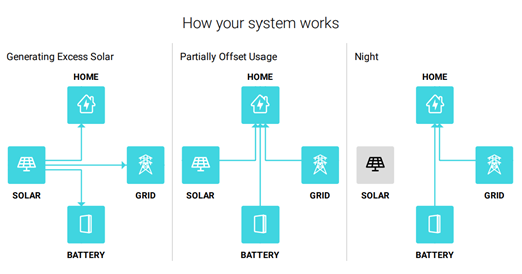
A solar system will generate during day-light hours where it will either partially off-set your grid imports or export any excess electricity back to the grid. Once sunlight levels reduce, system will stop producing and will start to solely rely on grid imports.
To maximise self-consumption and ultimately reduce energy savings, battery storage is added to a PV system. Battery storage works by storing surplus electricity from the pv system ready for you to use when you arrive home at night. By storing surplus electricity and using it at a later part of the day when price/kWh is at its highest, will ensure your energy bills remain low. At night, the battery will either cover the full property consumption, or partially off-set grid imports.
How much do solar panels cost?
There is more than one factor in working out the total price for installing panels to your home. Other than the price per panel, but also the number of panels, roof mounting system and costs of installing the panels.
Here’s a rough average you can expect to pay for different solar panel sizes across the UK:
| Panel Amount and output | Install Price | Average 30 year savings |
| 8 Panels – 385w | £3600 | £17,000-£23,000 |
| 8 Panels – 400w | £3700 | £21,000-£29,000 |
| 8 Panels – 405w | £3750 | £22,000-£29,500 |
| 8 Panels – 410w | £3800 | £23,000-£30,000 |
| 8 Panels – 415w | £4000 | £24,000-£31,000 |
| 8 Panels – 425w | £4100 | £25,000-£34,000 |
You’ll also have to think about labour. On average, costs per person, per day will range anywhere from £350-£500. Naturally, the more complex your solar array is, the longer it will take for someone to complete the work. On top of installation costs, depending on the type of property you own, is whether scaffolding will be required (on the average household for single elevation scaffold is roughly £400).
Just as with any home renovation, prices will naturally vary. Be sure to keep all the following in mind when it comes to what may affect the overall cost of your solar panels:
- The type of panels used. Different panels have varying levels of efficiency, longevity, and durability. That means you can expect to pay more for those which offer higher quality. It might be more of a hit upfront, but this could save you cash in the long run.
- The size of your entire array. Likewise, the number of panels you choose to attach will impact costs. This will be represented by both an increase in unit price and the time it will take for a labourer to fit them to your home.
- Where your home is located. Where you live in the UK might also impact installation prices. If it’s harder for a company to reach you, or your home is in any way dangerous to access, this could see premiums rise.
- What type and brand of inverter you use? – There are 2 types of inverters – String inverter and Hybrid inverter. String inverters are used for just standard PV installations, and Hybrid inverters are used when battery storage is to be installed along with solar pv. Also, the electrical size of your inverter required for your generation will vary in price. For example: If you have 8x 400w panels, this system totals 3.2kWp which would require a 3kw inverter. But if your system is much larger and requires a 5kw inverter, then the price would increase.
How much can you save with solar panels?
The single most important factor of installing solar panels to household roofs is the impact of their annual utility bills, and how quick the payback time is.
But based on Energy Saving Trust estimates, a typical household with a 3.5 kilowatt-peak system can knock between £160 and £420 a year off bills at the current Energy Price Cap rates.
Increase your savings by selling your excess energy
What you may not know is that thanks to the smart export guarantee (SEG), households are able to sell back energy they generate (but do not use) to their suppliers.
The amount you’ll be paid will depend on the company you operate with, but the national average for 2023 was 4.99p for every kWh of energy you gave back. This meant most households would earn back a further £80-£110 a year.
Here’s a rough breakdown of what you might expect to get for your surplus energy, depending on which supplier you use:
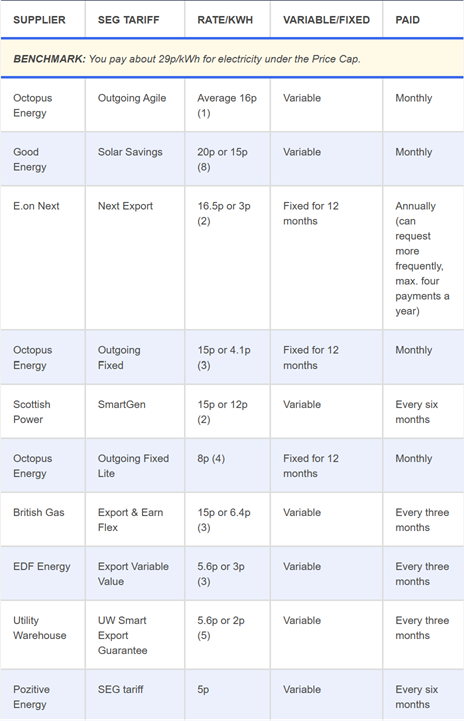
Source: Money Saving Expert
Will solar panels save you money?
That’s a lot of information to digest, so let’s take a practical look at a solar and battery storage system we installed in Darlington not too long ago.
We installed a 7.28kWp system, consisting of 16 x 455w Canadian Solar panels, 6kw Solar Edge inverter and a 10kWh SolarEdge battery storage unit. The system cost the customer £12,020 including installation.
These figures – which look at the average costs and energy consumption across the entire county – assess factors like annual electricity spend (with and without solar energy or photovoltaic (PV) production), the price of a solar unit, the cost of installation, property tax, and how much you might be able to get for selling energy back to the grid.
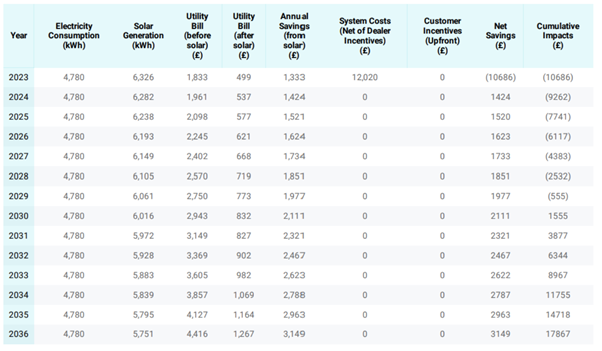
The system payback time was an estimated 7 years and 4 months. From the table above, we can see a cumulative impact from the savings from solar, against the initial £12,020 outlay. What is most interesting about this table, which a lot of people don’t think about, is what happens after the payback.
Well…
An average system lifespan is around 25-30 years. After the 7 years 4 months payback time has elapsed, the system is effectively generating the customer money year on year. From the table above, we can see the system will have cumulated a saving of 17,867 in just under 7 years.
Are solar panels worth it in the UK?
In recent years, we’ve observed extreme volatility in the energy market, resulting in obscene prices in the UK. Thus, many people figured it was only logical to do, was to reduce their reliance on utility suppliers as much as possible.
As seen above, many factors may impact your savings. Location and weather are on top of the list, together with others that shouldn’t be neglected, such as the quality of your equipment (a battery maximises savings, for example) and your energy consumption habits.
Do you feel like you have a better understanding of the true value of solar panels in the UK?
If you’d like to find out more about solar energy, be sure to get in touch with one of our team today at EO, or head over to our website to enquire for your free solar pv performance estimate and quote today!